Why record a sound that already happened?
A film set is not always a good place to capture clean footsteps, clothing rustles or the small sounds of someone handling an object. Dialogue may take priority, while traffic, equipment or a different floor surface can make the original sound unusable. Foley is the practice of performing and recording many of those sounds after filming, in sync with the picture. Rather than simply adding noise, a Foley artist helps the audience feel that a character occupies a particular space.
The work often goes unnoticed when it succeeds. A hand resting on a table may need a soft contact sound; a coat being pulled on may need a brief swish. These details can make movement feel continuous across camera cuts. Foley is one part of a wider soundtrack, alongside production audio, edited sound effects, ambience, dialogue and music. Which sounds are performed and which come from other sources depends on the needs of the project.
Footsteps are a performance
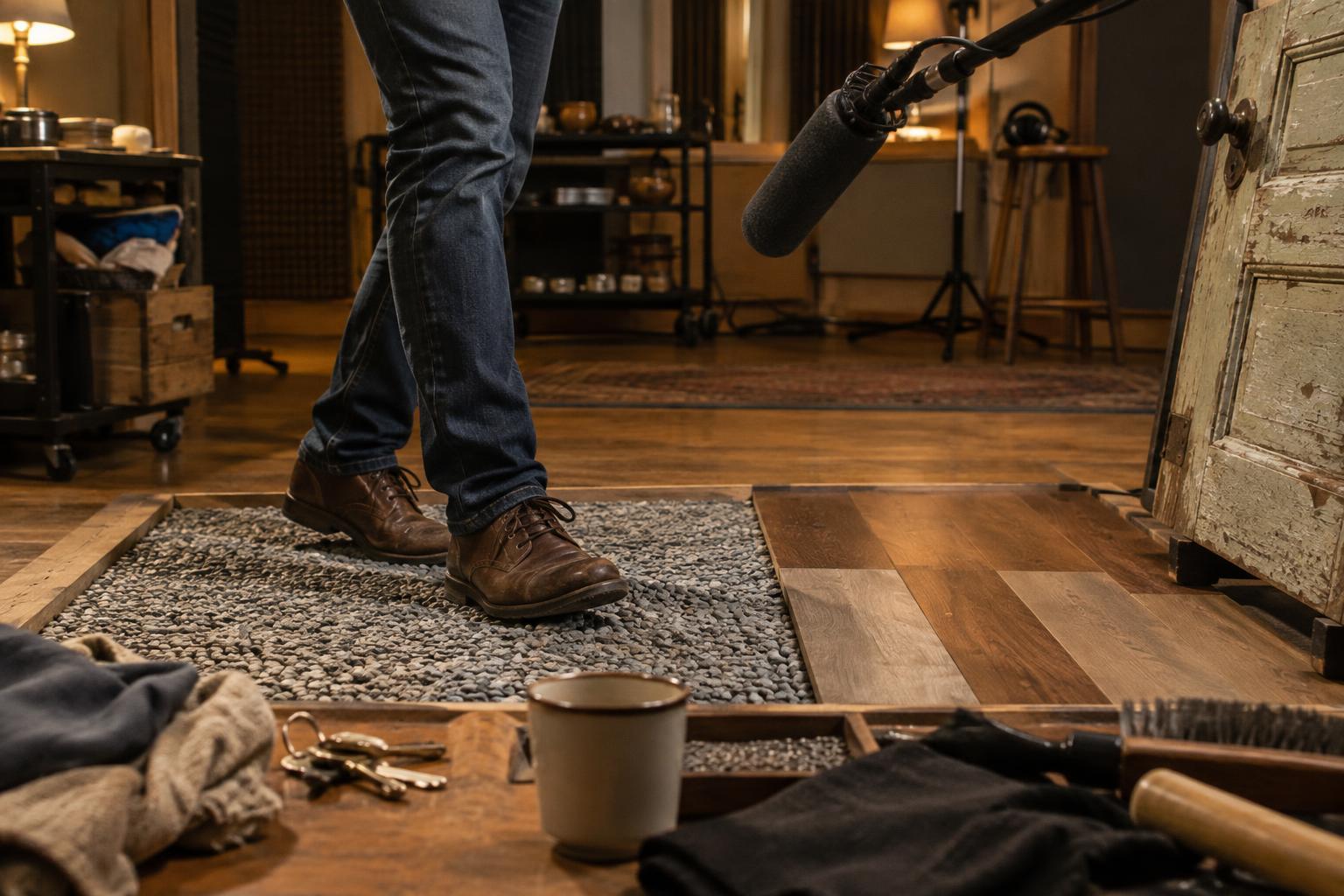
To create footsteps, an artist watches the scene and walks in time with the person on screen. Matching the rhythm is only the beginning. A hurried character may strike the ground differently from someone trying not to be heard. A pause, a shift of weight or a turn can matter as much as a full stride. The artist may perform several passes, refining the timing until the steps support the movement rather than call attention to themselves.
Shoes and surfaces supply the raw materials. A studio might keep footwear with different soles and build small areas that suggest wood, gravel, carpet or other ground. The goal is not always to reproduce the exact material seen on screen. It is to find a sound that reads convincingly in the finished scene. A heavy tread can make a character seem more forceful, while a lighter one can preserve a quiet mood. Such choices are made in conversation with the picture and the rest of the soundtrack.
Ordinary objects need careful listening
Foley extends well beyond walking. Artists may handle fabric to follow a character’s clothing, set down a cup, turn a page, open a bag or jostle keys. These actions are familiar enough that an audience may sense when they sound wrong, even if they cannot name the problem. The sound has to arrive at the right moment, but it also needs the right texture: a ceramic cup meeting a hard counter suggests something different from a paper cup placed on a soft surface.
The prop used in the studio may differ from the object in the shot. A substitute can be easier to control or may produce a clearer sound at the scale the scene needs. Artists also have to avoid overdoing it. If every gesture produces a prominent clink or rustle, the soundtrack can become crowded. Deciding when an action should remain quiet is part of the craft, particularly in scenes where dialogue, music or silence carries the attention.
Building a believable perspective
A sound’s character depends not just on what makes it, but on how it is recorded. Microphone placement can emphasize a close, crisp detail or allow a little more space around an action. Recording separate takes gives editors options when a scene changes perspective: footsteps that suit a close view may feel too distinct under a distant shot. The artist and recording team work with these possibilities while watching how the sound fits the image.
After recording, the sounds may be edited for timing and passed into the broader sound mix. Their level and placement are balanced against dialogue, ambience, effects and music. A single footstep might need to stand out at a dramatic pause, while dozens of others should blend into the scene. Foley does not have to be loud to be useful; often its contribution is the subtle sense that a movement has weight, contact and continuity.
The small sounds that support a big moment
Foley is easy to think of as a collection of clever prop tricks, but its central skill is observation. Artists notice how an action begins, where the weight falls and when an object stops moving. They then turn those observations into a repeatable performance, using the materials available to them. The result is shaped by both practical problem-solving and an ear for character.
The next time a scene follows someone across a room, listen past the dialogue for a moment. The changing pace of the steps, the brush of clothing and the touch of a hand on a door may all help tell the story. When those sounds feel inseparable from the image, Foley has done its work without demanding the spotlight.