Start by asking whose version you are watching
In a novel, an unreliable narrator may speak directly to the reader. Film has more ways to shape a point of view. A voice-over can tell us what happened, but the camera, editing and soundtrack can also make one character’s account feel like the whole story. The first question is not simply “Is this person lying?” It is “How much of what I see depends on this person’s memory, knowledge or interpretation?”
Look at how a scene begins. Does it follow a character into a recollection, dream or retelling? Are we shown events that only this character could know, or are we watching from a more independent vantage point? A film may move between those modes without announcing the change. Noticing the boundary helps you distinguish an event presented as shared reality from one presented as somebody’s account.
Separate deception from limited understanding
A narrator can be unreliable without deliberately misleading anyone. A character might remember selectively, misunderstand another person’s motives or leave out details that seem unimportant at the time. Fear, pride and loyalty can shape an account as strongly as an intentional falsehood. That is why a character’s confidence is not proof that their version is complete.
Pay attention to what the character stands to gain by telling a story a certain way. Do they want sympathy, control or reassurance? Then ask what they could not reasonably know. If someone confidently describes another character’s private intentions, the film may be showing an assumption rather than a fact. This approach keeps the focus on how the story is constructed, rather than treating confusion or distress as automatic evidence of unreliability.
Watch for small conflicts between words and images
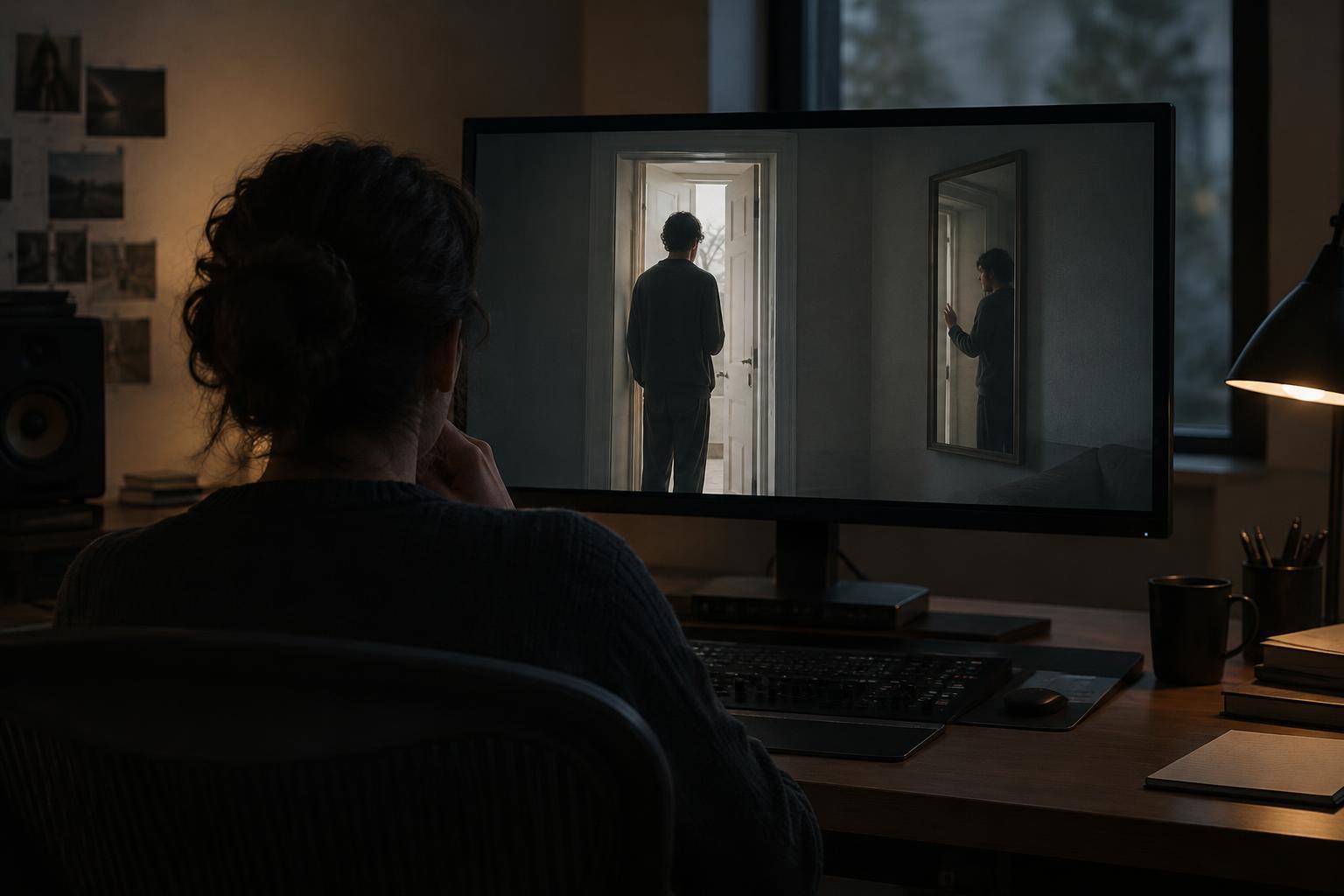
One of the clearest clues is a gap between what a character says and what a scene shows. They may call an encounter friendly while the other person appears uncomfortable. They may describe a choice as inevitable while the frame quietly reveals an alternative. Neither detail has to be decisive on its own. Repeated differences between an account and the visible behavior around it are more useful than a single suspicious line.
Objects and locations can also test a version of events. Notice whether a detail appears in one telling but disappears in another, or whether a repeated scene places people differently. Such changes might signal a shifting memory, though they can also be ordinary filmmaking choices. Rather than treating every continuity difference as a secret message, ask whether the film draws your attention to it and whether it changes your understanding of a character’s account.
Listen to how the film guides your certainty
Sound can make a perspective persuasive before you have considered its limits. A confident voice-over may continue across images that do not quite support it. Music may make a memory feel warm or threatening, while sounds from outside the frame suggest something the speaker is overlooking. When a film suddenly removes that guidance, you may become aware of how strongly it had shaped your response.
Editing matters, too. A quick cut can turn two separate moments into an apparent cause and effect. A scene that ends before someone replies can leave the narrator’s claim unchallenged. Later, a return to the same moment may supply the missing response or a wider view. When you sense a film asking you to accept a conclusion, pause and identify what it actually showed—and what you supplied yourself.
Test your reading without hunting for a twist
A useful test is to hold two possibilities in mind: the character’s account is broadly accurate, or it is incomplete in a particular way. Which scenes support each possibility? Look especially for moments outside the character’s control, such as another person’s independent account or a scene the narrator does not witness. Those moments may provide a check, although films can complicate them as well.
Not every contradiction means a narrator is unreliable, and not every film with an unreliable perspective is building toward a revelation. Sometimes the point is to show how people make meaning from partial information. Watching for point of view, omissions and competing evidence can deepen your attention to performance and filmmaking even when the story never offers a final answer. The goal is not to outsmart the film; it is to notice how it invites you to believe.