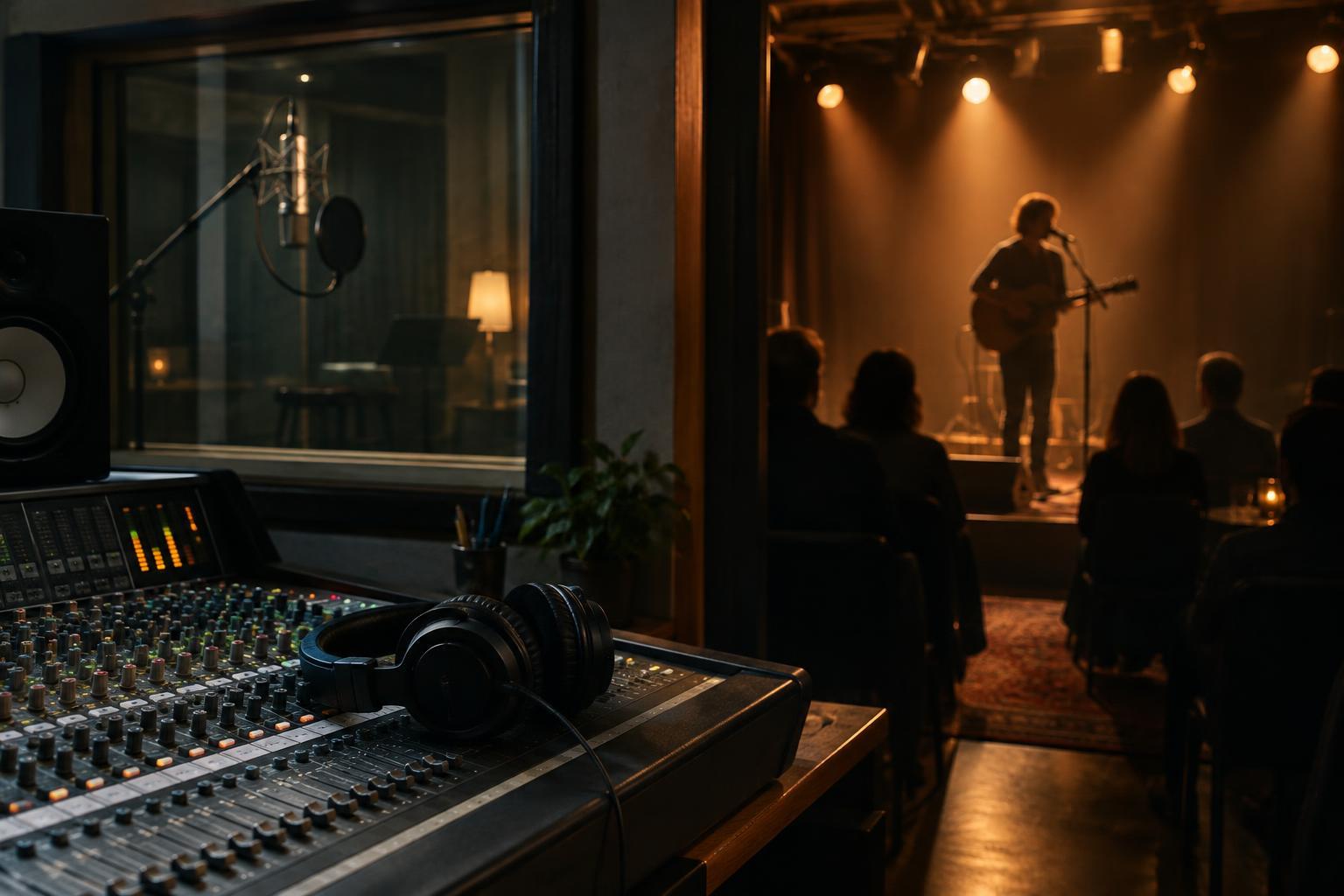
Start with two different listening experiences
A studio version gives you a carefully shaped encounter with a song. Parts can be recorded separately, repeated and balanced until small details sit where the artists want them. A live performance unfolds in a particular room, on a particular night, with musicians and listeners responding to one another in real time. Neither format is automatically more authentic. Each shows a different way a song can work.
For a useful comparison, listen to the studio track first, then a full live rendition if one is available. Choose a performance where you can hear the song clearly enough to follow its structure; a distant phone recording may tell you more about the person holding the phone than about the music. On the first pass, notice your overall reaction. Does the song feel intimate, tense, playful or expansive? Save the close analysis for a second listen.
Follow the arrangement, not just the melody
The most revealing changes often happen around the lead vocal. A recorded song might open with a quiet instrument and add layers verse by verse, while a live band begins at full force to draw a room in immediately. Listen for added introductions, shortened sections, extended instrumental passages and changes in who carries the main musical idea. Notice whether a backing part becomes prominent or disappears altogether.
Tempo matters, too, but it is more useful to ask what a change does than to label it faster or slower. A brisker chorus may invite movement; a held-back verse may give the words more space. Musicians may also leave gaps for a solo, a singalong or a moment of silence. If you know the studio arrangement well, try listening to the live version once without mentally filling in every missing sound. What the performers leave out can be as expressive as what they add.
Listen to the performance choices
A singer may phrase a familiar line differently onstage, stretching one word and moving quickly through another. Instrumentalists can make similar choices through dynamics, articulation and timing. These variations do not necessarily mean the performers have changed their interpretation of the song. They may be responding to the other players, the room or the demands of that performance.
Compare a few specific moments rather than trying to judge an entire rendition at once. Does the singer approach a difficult phrase with force in the recording but restraint onstage? Does a guitar part that sounds crisp in the studio become rougher and more rhythmic live? Consider what each choice brings forward: a lyric, a groove or a sense of risk. Small differences become easier to appreciate when you describe what you hear before deciding which version you prefer.
Account for the room and the recording
Sound quality can shape your impression as strongly as the performance itself. Studio tracks allow detailed control over volume and placement. In a live recording, the room, microphones, sound mix and audience all affect what reaches your ears. A drum that seems dominant may have been especially loud near the recording position. A subtle harmony may have been present onstage but difficult to capture.
Audience noise is worth listening to rather than automatically tuning out. Applause, singing and quiet attention can alter the space a performer gives a passage. At the same time, a crowd’s reaction is not a reliable measure of musical quality: listeners may be responding to recognition, spectacle or a moment shared with friends. If you can watch the performance, look at how the musicians communicate, but keep sight and sound separate in your notes. A striking visual moment can change how you remember what you heard.
Make a comparison that leaves room for both
A simple set of questions can keep the exercise focused: What stays recognizable? What changes in the arrangement? Which performance choices stand out? How much of the difference might come from the way each version was recorded? You do not need technical vocabulary to answer. Descriptions such as “the chorus has more space” or “the voice sounds closer to the listener” can be more useful than an unsupported verdict about which version is better.
In the end, preference can depend on what you want from the song. You might return to the studio version for a carefully placed detail and to the live version for the way a passage opens up in front of an audience. Comparing them is not a contest to find the definitive take. It is a way to hear how composition, preparation and in-the-moment decisions give familiar music more than one life.